After three heatwaves in just seven weeks, keeping our homes cool is becoming an increasingly urgent issue. The UK has already experienced several record-breaking temperatures in 2026, including a new May high of 35.1°C. England has also recorded its warmest June since records began.
For homeowners in Solihull and across the West Midlands, these repeated spells of intense heat have exposed a problem many of us have previously overlooked during cooler weather. Large windows, bifold doors and south or west-facing rooms allow strong sunlight to enter throughout the day, causing heat to build up behind the glass. Even when temperatures begin to fall outside, our homes have remained uncomfortably warm well into the evening.
Air conditioning may seem like the obvious solution, but units can be expensive to purchase and run, particularly when demand rises during prolonged hot weather. Air conditioning also consumes additional energy, so reducing heat gain through effective shading is a better route to take.
In this guide, we explain how to keep your house cool without AC, why external shading is more effective than relying on internal blinds alone, and how a carefully planned awning can protect your windows during the hottest parts of the day.
- Keep sunlight out before your rooms get hot
- Close your windows when it is hotter outside
- Reduce unnecessary heat inside your home
- What blinds and shutters can keep your house cool without AC?
- Why external shading is more effective
- How an awning can help keep your home cool
- Consider an external screen for low sun and glare
- See where the shade will fall with weinorVision
- Find the right awning for your Solihull home
Keep sunlight out before your rooms get hot
Glass allows short-wave solar energy to pass into a room. Once that energy reaches your flooring, furniture and other surfaces, it is absorbed and released as heat. This is why a bright kitchen extension or living room can continue feeling hot even after the strongest sunshine has passed.
To keep your house cool during a heatwave, you need to act before your rooms have a chance to heat up. Close your blinds or shutters before direct sunlight reaches your window. Do not wait until your room already feels uncomfortable, as much of the heat will already be inside.
Close your windows when it is hotter outside
Opening every window can feel like a natural response to hot weather, but it is not always helpful.
When the temperature outside is higher than the temperature inside, open windows can allow more warm air into your home. During the hottest part of the day, it may be better to keep windows closed and use shading to block the sun.
Once the outdoor temperature falls in the evening, open windows on different sides of the house to encourage air to flow through. Cross-ventilation can help release some of the heat stored inside the building.
Reduce unnecessary heat inside your home
It’s easy to forget this, but appliances, lighting and cooking can all add unwanted warmth to your rooms.
During a heatwave, some simple changes can help:
- Avoid using the oven during the hottest part of the day.
- Turn off lights and electrical equipment when they are not needed.
- Run dishwashers and washing machines later in the evening.
- Choose cooler meals that require less cooking.
- Move computers and other heat-producing equipment away from the hottest rooms.
These changes may seem small, but they work together to reduce the amount of heat your shading and ventilation need to manage.
What blinds and shutters can keep your house cool without AC?
Roller blinds with suitable fabrics reduce brightness and help protect furnishings from direct sunlight. Venetian blinds allow you to adjust the angle of the slats, giving you control over light levels throughout the day. Shutters provide flexible privacy and shading while becoming an aesthetically pleasing feature of the room.
Specialist insulating blinds with a honeycomb structure work to create an additional layer at the window. They help improve temperature control in both summer and winter. Light-coloured or reflective materials may also help manage solar energy more effectively than dark fabrics that absorb heat.
Internal shading has many practical benefits, but it has one important limitation. By the time sunlight reaches an internal blind or shutter, it has already passed through the glass.
Why external shading is more effective
To keep your house cool without AC, you need to stop heat before it enters your rooms.
Rather than allowing strong sunlight to pass through the window, an external shading product intercepts it outside the building. This reduces the amount of solar energy reaching the glass and entering the room.
External shading works especially well for:
- Large bifold and sliding doors
- South and west-facing windows
- Kitchen extensions
- Glazed dining areas
- Conservatories and garden rooms
- Rooms that regularly experience strong afternoon sun
External shading does not mean that internal blinds are unnecessary; the two can work together. Internal blinds or shutters provide privacy, decoration and fine control over indoor light. External shading addresses the larger issue of solar heat before it enters the home.
How an awning can help keep your home cool
When you think of a retractable awning, you probably imagine creating shade over a patio. However, an awning can also reduce the amount of direct sunlight reaching the rooms behind your patio.
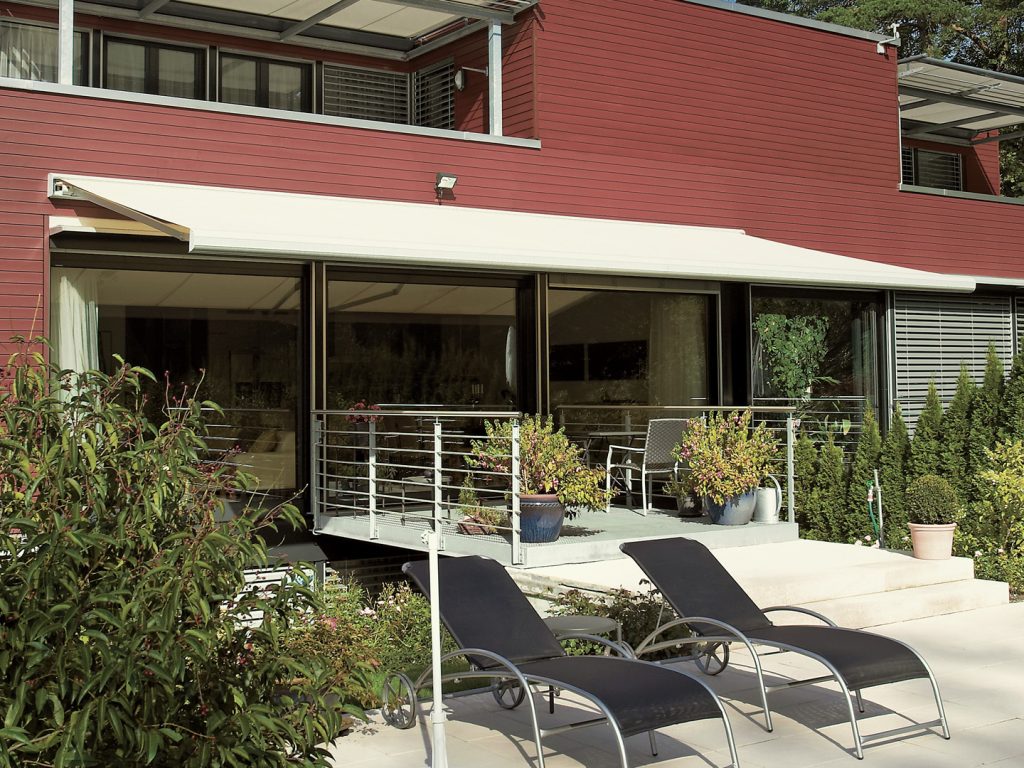
When installed above bifold doors, French doors or wide windows, an awning creates shade across the glazing. By reducing the amount of direct sun reaching the glass, it can help limit heat build-up inside the adjoining kitchen, dining room or living space.
This gives you two benefits at the same time. Outside, the awning creates a more comfortable place to sit, eat or spend time with family. Inside, it helps protect your rooms from strong sunshine.
A retractable awning also gives you flexibility. It can be extended when shade is needed and retracted when you want more daylight or warmth. This can be useful during spring and autumn, when free heat from the sun is welcomed.
With motorised controls, adjusting your awning is straightforward. Depending on the chosen awning model and accessories, options may include remote controls, app-based operation and weather sensors.
The size and position of your awning is important
An awning needs to be planned carefully if your goal is to shade particular windows during the hottest part of the day.
The position of the sun changes by the hour and by the season. A small projection may shade a patio at one time of day but leave the glazing exposed later in the afternoon. The installation height, awning angle, width and projection can all affect where the shade falls.
The orientation of your property matters too. A south-facing elevation experiences sunlight differently from a west-facing garden. Nearby buildings, trees and other structures may also influence the result.
This is why choosing an awning based only on a brochure image or rough measurement can be difficult. You need to understand how the proposed product will interact with your actual home.
Consider an external screen for low sun and glare
An awning provides overhead shade, but low-angle sunlight can still reach windows and glazed doors during the morning or late afternoon. A vertical external screen, such as the weinor VertiTex II, can provide additional protection against low sun, glare and heat before they enter your home.
External screens can work alongside an awning or as a separate shading solution for exposed glazing. As well as helping rooms stay more comfortable, they can improve privacy while still allowing you to manage the amount of daylight entering the space.
See where the shade will fall with weinorVision
At Solihull Blinds, we have recently begun offering weinorVision: an Augmented Reality (AR) service that helps you experience a weinor awning in 3D at your own property before it is installed.
The visualisation is created using the real dimensions of your patio and specific product information. This allows you to explore how different awning sizes, projections, colours and proportions could work with your home.
Crucially, weinorVision can also visualise how light, sun and shade change throughout the day. You’ll be able to see where the shadow created by the awning is expected to fall at different times. If your main aim is to protect bifold doors or windows from intense afternoon sunshine, the visualisation can help confirm whether a proposed size, projection and position will shade them at the times that matter most.
weinorVision also helps you assess the appearance of the awning. You can see how its proportions work with the building, how the frame and fabric complement the exterior, and whether the finished installation will suit the way you use your patio.
Overall, weinorVision provides a much clearer basis for making your decision than relying on imagination alone.
Find the right awning for your Solihull home
Keeping your house cool without AC starts with preventing strong sunlight from reaching your windows in the first place. By combining sensible ventilation strategies, effective internal blinds and well-planned external shading, you can reduce heat build-up and create a more comfortable home throughout the summer.
Solihull Blinds has been helping homeowners choose made-to-measure blinds, shutters and awnings for more than 50 years. From our showroom in Shirley, we work with customers across Solihull, Birmingham, Coventry and the wider West Midlands. Our team can help you identify which windows are contributing to overheating and explain the internal and external shading options available.
For homeowners considering a weinor awning, a weinorVision demonstration allows you to see the proposed product at your own property, explore different designs and understand how the shade could move throughout the day.
Contact Solihull Blinds to arrange your weinorVision demonstration and start planning an awning that provides useful shade where and when your home needs it most.